
'We are going to have a recession this year, maybe next year too...'

FY14 economic growth rate pegged at 4.8-5.3%, WPI inflation set to rise

The tourism industry plays a vital role in the town, accounting for 70 per cent of its economy, according to experts.
A well-functioning GST will enhance tax compliance and boost growth: IMF

India is among 75 countries with which Switzerland's Federal Tax Administration has exchanged information on financial accounts within the framework of global standards on Automatic Exchange of Information.

A shocking fact revealed by a pan-India survey that was flagged at a seminar of Dalit intellectuals

To propel demand, one should concentrate on indirect taxes and bring down the goods and services tax (GST) rates to a uniform 12 per cent as the Vijay Kelkar panel had recommended, said Ajit Ranade, chief economist at Aditya Birla Group.

The National Council of Applied Economic Research (NCAER) on Thursday lowered the GDP projection for the current fiscal to 4.7-4.9 per cent due to exchange rate depreciation.

The NCEAR has indicated some improvement in the fourth quarter of the current financial year.

This is the lowest that the BCI has ever fallen in the history of 113 rounds of the NCAER Business Expectations Survey.

De-scaling of businesses, job losses and subsequent impact on disposable incomes has created negative sentiment among traders, business owners and workers alike, says Abhishek Waghmare.

He was most recently credited as one of the brains behind labour law reforms in Rajasthan
NCAER said the monetary policy measures are unlikely to revive growth at this juncture and suggested providing fiscal stimulus, which too can be challenging unless it can be financed through better revenue generation.

19 per cent of all travel in India (by bus, train or air) was pilgrimage or religious travel (possibly the single largest after business and family-related travel), discovers Ambi Parameswaran.
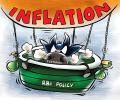
The RBI's Monetary Policy Committee brainstormed the impact of any future shocks on the inflation trajectory and stressed monitoring the cumulative effect of monetary policy actions over the past one year, which is still unfolding, revealed minutes of the rate-setting panel released on Thursday. The minutes of the meeting of the Monetary Policy Committee (MPC), headed by Reserve Bank Governor Shaktikanta Das, also indicated it would be premature to declare an end to the monetary tightening cycle, which started in May 2022 to check high inflation following the outbreak of the Russia-Ukraine war. The central bank, which effected six back-to-back hikes in the key short-term lending rate (repo) since May 2022 to check high inflation, decided to take a pause early this month.
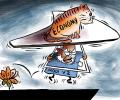
The reform priorities are clear: enhance savings, improve productivity. Just 25 basis points of moving interest rate up or down would not boost investment: Former RBI Governor Y V Reddy.

His vision drove ITC to pursue business models that today support over 6 million livelihoods, many amongst the weakest in society.

The report by the High Level Advisory Group said India stands to benefit even more when the US and China are locked in a global trade war.

The Centre should privatise all public sector banks (PSBs), except the State Bank of India (SBI). This is because private banks have emerged as a credible alternative to PSBs with substantial market share. Also, government ownership hinders the ability of the Reserve Bank of India (RBI) to regulate the sector, according to a report by the National Council of Applied Economic Research (NCAER).

Muhammad Yunus proved that he was neither an armchair economist nor a slogan mongering political activist, but a doer destined to do what Mahatma Gandhi said -- to remove every tear from every eye, recalls Rup Narayan Das.

'We have to think of the repercussions if public sector banks are privatised and if they go to foreign hands.'

'One way to deal with these is to address these quickly and have rapid reaction teams in New Delhi, the state capitals and wherever possible.'
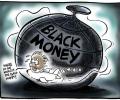
The studies found that sectors with the highest unaccounted income included real estate, mining, pharmaceuticals, pan masala, gutkka and tobacco, bullion and commodity markets, film industry, educational institutes and professionals.

Several speakers noted that Budget carried the weight of expectations.

For India to view the new Sri Lankan leadership only through the prism of the past or through their narrow view on China, is fraught with possibilities that should be avoided, asserts N Sathiya Moorthy.
.jpg)
The Finance Ministry had set a time period of 18 months, which expired last year on August 21, for completion of the study.

Should we not be creating roles in India for the talented, asks Ajit Balakrishnan.

It was better to first build a single-rate GST with a low rate, achieve full mastery of this, and then consider more complex possibilities such as high rates and multiple rates.

This makes him corporate India's biggest donor to society.

'How low GDP would have been, we don't know.' 'It raises serious questions because so many indicators are pointing to such a sharp decline and GDP estimates are still showing 4 per cent growth.'

Rajan said that while there were talks about Jan Dhan, it was difficult to target transfers to people through this tool. Jan Dhan, he said, does not really work as advertised.

Although the credit for acquiring the technological skill must be given to India's outstanding nuclear scientists, the decision to go nuclear was a political one that entailed clarity of vision, courage and resolve, points out Rup Narayan Das.

Nationalisation has served its purpose. It's time to move ahead, keeping majority ownership of the government in a few banks to serve the people, argues Tamal Bandyopadhyay.
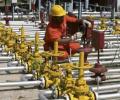
Pooling will also kick-start projects of Reliance Power, Torrent, Lanco.

At a time when investors are taking a "wait and watch" approach on fresh investment, Tamil Nadu in the past 10 months has signed 63 MoUs, enabling investment worth Rs 19,083 crore. After Palaniswami took over as chief minister in February 2017, cumulative FDI rose by Rs 46,427 crore from Rs 133 trillion (April 2000 to March 2017) to Rs 180 trillion by June this year. Thanks to the Tamil Nadu Business Facilitation Act, 2018, and the single window for applying and getting clearance for doing business, the ease of business issue has been addressed.

'Outside investors don't want to get tangled up in a religious war.'

'At this stage, you should distribute money and food.' 'Like you queue up to vote, let people queue up to collect this.' 'This will arrest the decline in demand which will have a multiplier effect on the demand side for the economy as a whole.' 'The government should earmark about 2% of the GDP for this.' 'And this should be the first step to revive the economy.'
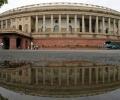
A reformed Planning Commission should reflect the diversity of Indian debate.
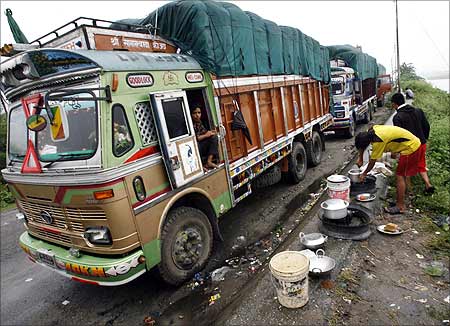
A strong proponent of the GST, Adi Godrej has been saying for five years or more that it will add one per cent to India's gross domestic product (GDP).

Neutrality and jurisdiction in international trade need to be discussed threadbare before GST is implemented in India.
